

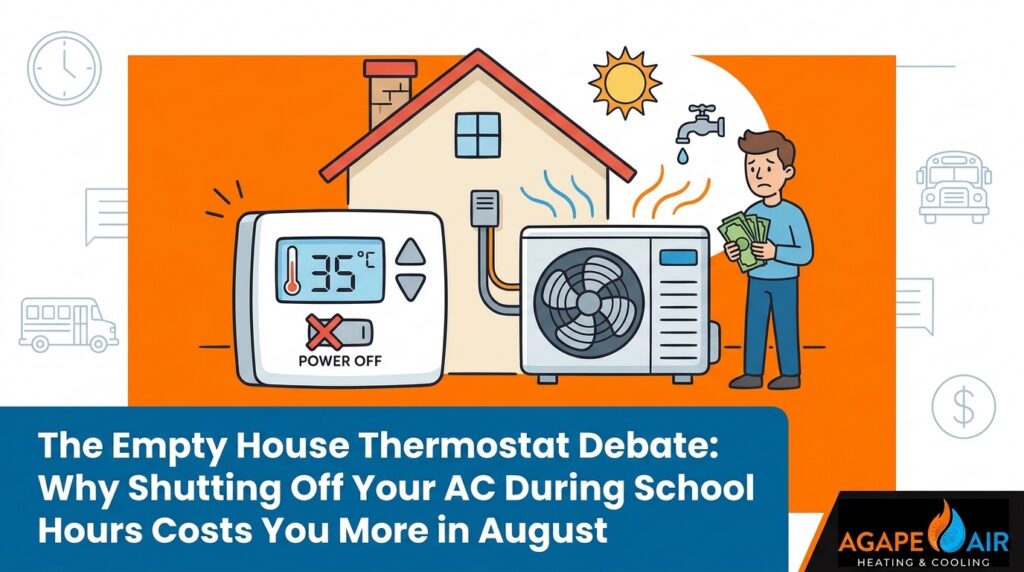
The Late-Summer Cooling Dilemma for Empty Houses
If you are staring at your control panel wondering how to save energy now that the kids are back in class, you have likely stumbled into the empty house thermostat debate: why shutting off your AC during school hours costs you more in August. Your AC has been running nonstop all summer, but with the sudden shift in household routines during the August back-to-school transition, the house sits completely empty during peak daytime heat. The common instinct is to turn the thermostat way up—or shut the system off entirely—to give your utility bill a break while no one is home to enjoy the cool air.
When navigating this seasonal shift, balancing your energy costs with proper residential AC maintenance is the key to figuring out how to improve your AC efficiency without breaking your system. The central debate for homeowners centers on a simple question: Does a drastic temperature setback actually save energy, or does it create a much larger, more expensive mechanical problem later in the day?
The Shift in Household Routines
During June and July, constant foot traffic, open doors, and occupied rooms make it obvious that the air conditioning needs to run steadily. However, once August arrives, the house falls quiet from 8:00 AM until 3:30 PM. This sudden 8-hour block of vacancy makes it incredibly tempting to bump the thermostat from 74 degrees up to 85 degrees. On paper, it seems like basic math: less cooling time equals less energy used.
The Mechanical Reality of Cooling
The flaw in this logic is that air conditioning systems are not designed to perform rapid, massive temperature drops during the hottest part of the day. Maintaining a steady, consistent temperature is crucial for overall system health and efficiency. Forcing your equipment to recover from a drastic setback requires immense sustained power, which often cancels out any energy savings achieved during the morning hours.
Why the Standard 10-Degree Setback Fails in the Desert
If you search for ways to save energy while away from home, you will almost certainly encounter generic national advice. The U.S. Department of Energy generally recommends setting your thermostat back 7 to 10 degrees for 8 hours a day to achieve optimal savings. While this sounds like a foolproof plan, applying this generic advice blindly during the August back-to-school transition in a desert climate is a recipe for disaster.
The Problem with National Averages
The moderate climate assumption: The standard 10-degree setback rule was designed for moderate climates—places where summer temperatures peak in the mid-80s and homes naturally cool down overnight. In those environments, turning off the AC during the day means the indoor temperature might only rise a few degrees, and the system can easily catch up when the sun begins to set.
The Desert Climate Reality
The extreme heat variable: In extreme desert environments, the math changes completely. Allowing a house to heat up drastically creates an unmanageable thermal load. When outdoor temperatures exceed 110 degrees, an unconditioned house does not just get warm; it bakes.
To understand why the national advice fails locally, look at the difference in daily cooling demands:
| Climate Factor | Moderate Climates (DOE Baseline) | Extreme Desert Climates (Arizona) |
|---|---|---|
| Peak Afternoon Heat | 82°F to 88°F | 105°F to 115°F+ |
| Overnight Recovery | Drops into the 60s, natural cooling | Stays in the mid-80s to low-90s |
| System Recovery Effort | Light workload, short cycles | Maximum capacity, hours of continuous operation |
This massive difference in outdoor conditions directly impacts how your home physically absorbs heat, which involves much more than just the temperature of the air floating in your living room.
Understanding Thermal Mass in Your Home
To truly understand why shutting your system down is counterproductive, you have to look at the physical structure of your house. Thermal mass is defined as the ability of heavy, dense materials to absorb, store, and slowly release heat energy. In your home, this includes drywall, tile flooring, hardwood, heavy furniture, cabinetry, and even the structural framing.
The Heat Sponge Effect
When the AC is turned off or set back drastically, your house’s structure acts like a giant sponge, soaking up the intense outdoor heat. With Gilbert’s relentless August sun aggressively baking the exterior of the home all day, that heat energy transfers straight through the insulation and into the interior thermal mass.
- Your walls: Drywall absorbs heat deeply and holds it for hours.
- Your floors: Tile and concrete slabs become massive thermal batteries, storing warmth from sunlight streaming through windows.
- Your furniture: Couches, beds, and heavy wooden tables soak up the ambient heat inside the room.
Cooling Objects, Not Just Air
The short answer is that your air conditioner does not just cool the air; it cools the physical objects inside the house. When the AC kicks back on after sitting idle, it must first extract the deep-seated heat from the couches, floors, and walls before the ambient air temperature can permanently drop.
If you let the house reach 85 degrees, the air might cool down in 30 minutes, but the walls and furniture will continue radiating stored heat into the room for hours. This trapped heat creates a massive, sustained workload for the HVAC system, forcing it to run continuously to fight the heat radiating from your own living room walls.

The 3 PM Danger Zone: Peak Heat and Compressor Strain
The most dangerous part of the drastic setback strategy happens precisely when the school day ends. Imagine the thermostat is programmed to kick on just as the kids get off the bus at 3:00 PM. At this exact moment, the house has reached 85 degrees at 3 PM, and the outdoor temperature is hitting its absolute peak for the day.
The Mechanical Toll on Your Equipment
The extreme recovery burden: Attempting to drop the indoor temperature multiple degrees when it is well over 100 degrees outside is mechanically punishing for the equipment. Your AC compressor is the heart of the system, responsible for pumping refrigerant and removing heat. When faced with a heat-soaked house at peak outdoor temperatures, the compressor must run continuously at maximum capacity.
Relentless, non-stop operation during extreme heat is a primary driver of premature compressor failure. Air conditioners are designed to run in cycles—turning on, cooling the space, and turning off to rest. When a system runs for three or four hours straight without a break, the internal components overheat, capacitors degrade faster, and the compressor sustains massive wear and tear.
Real-World Consequences
A typical pattern we see involves systems failing exactly when they are pushed to these extremes. One local homeowner reached out during a busy 110-degree day when their air conditioning simply stopped working. The system had been pushed beyond its limits trying to recover from the afternoon heat. A technician provided a thorough diagnosis of the AC issue, ensuring the problem was addressed effectively without relying on a quick band-aid fix.
Instead of forcing your system into a daily marathon, maintaining short, steady cycles throughout the day prevents this massive afternoon heat recovery burden. This approach is essential for keeping your air conditioner operating better and longer.
The Hidden Financial Penalties of Drastic Temperature Setbacks
Most homeowners don’t realize that the strategy they are using to save money on their electric bill might actually be costing them more in hidden fees and future repairs. The financial penalties of the empty-house setback strategy go far beyond the daily kilowatt-hour count.
Time-of-Use Peak Pricing
Continuous afternoon AC operation perfectly misaligns with local utility time-of-use (TOU) peak pricing hours. In many desert communities, utility companies charge significantly higher rates for electricity used between 3:00 PM and 6:00 PM or 4:00 PM and 7:00 PM.
If you let your house reach 85 degrees at 3 PM, your air conditioner will have to run non-stop during the exact window when electricity is most expensive. The electricity used to run continuously for three hours at peak rates often exceeds the cost of running short, efficient cycles all day during off-peak hours.
The Cost of Wear and Tear
Beyond the utility bill, there is the hidden cost of accelerated wear and tear. “Saving” a small amount on the daily electric bill frequently leads to expensive, major component breakdowns. Agape Air prioritizes real-world desert physics and compressor longevity over generic national energy-saving tips that don’t work locally. We know that replacing a burnt-out compressor costs significantly more than running the AC a few extra hours a week.
Another common situation occurs when equipment is pushed too hard during peak heat. One local homeowner experienced an air conditioning unit going out on a scorching 119-degree day. The fan motor was replaced quickly, and the unit was repaired and cooling the house again, but avoiding that extreme operational strain is the ultimate goal. Preventing a breakdown is always more cost-effective than a major emergency repair, which is exactly why understanding common AC problems in the summer is so important.
The Smart Setback Strategy for Desert Summers
You do not have to leave your thermostat set to 72 degrees all day to protect your equipment, but you do need a strategy that respects the climate. The actionable solution for balancing energy savings with system health in Gilbert AZ involves a moderate, controlled approach.
- Choose a narrow setback range: We recommend a safe, narrow setback range—typically 2 to 3 degrees—rather than a drastic 10-degree jump. If your ideal evening temperature is 75 degrees, do not set the daytime temperature higher than 78 degrees.
- Protect the thermal mass: Maintaining a closer temperature prevents the home’s thermal mass from becoming deeply heat-soaked. The walls and furniture stay relatively cool, meaning the AC only has to cool the ambient air when you return home, rather than fighting hours of stored heat.
- Leverage smart technology: Programmable and smart thermostats are excellent tools for managing these slight adjustments automatically. You can program the system to drop the temperature back down to your preferred comfort level about an hour before the kids get home, ensuring the house is comfortable without forcing the system to panic at 3:00 PM.
- Prioritize system health: Advise on the importance of regular system maintenance to ensure the AC can handle late-summer demands efficiently. A system that is low on refrigerant or struggling with a dirty condenser coil will have an even harder time recovering from a setback. Scheduling a routine AC tune-up ensures your equipment is operating at peak efficiency.
Frequently Asked Questions
Does it cost more to cool a hot house or keep it cool?
In extreme desert climates, it generally costs more to cool a completely hot house than to maintain a steady temperature. When a house gets too hot, the thermal mass (walls, floors, furniture) absorbs the heat. Your air conditioner then has to run continuously at maximum capacity during peak utility rate hours to extract that deep-seated heat, which drives up energy consumption and causes severe mechanical strain.
What is the best AC setting for an empty house in Arizona?
The best setting is typically just 2 to 3 degrees higher than your normal comfort preference. If you like the house at 76 degrees when you are home, setting it to 78 or 79 degrees while the house is empty provides a safe balance. This narrow setback saves some energy without allowing the physical structure of the home to become heat-soaked.
Is it cheaper to leave the AC on all day in the summer?
Yes, allowing the AC to run in short, normal cycles throughout the day is often cheaper than forcing it to run continuously for hours in the late afternoon. This is especially true if you are on a time-of-use utility plan, as continuous afternoon operation forces you to buy maximum electricity during the most expensive peak-rate hours.
What temperature should I set my AC when away?
When away for the day, a 2 to 3 degree setback is ideal for desert climates. If you are going on a longer vacation for several days or weeks, you can safely set the thermostat slightly higher, such as 80 to 82 degrees, because you will not be forcing the system into a rapid, daily recovery cycle during peak afternoon heat.
How does thermal mass affect indoor cooling?
Thermal mass refers to heavy materials like drywall, tile, and furniture that absorb and store heat energy. When the AC is turned off, these materials act like sponges, soaking up the heat from outside. When the AC is turned back on, it must work overtime to pull the heat out of these solid objects before the air in the room can actually feel cool.
Can running the AC continuously at peak heat damage the compressor?
Yes, relentless operation during the hottest part of the day is a primary cause of premature compressor failure. Compressors are designed to cycle on and off to prevent overheating. When forced to run for several hours straight to recover from a drastic temperature setback, the internal components overheat, significantly shortening the lifespan of the equipment.
The Empty House Thermostat Debate: Why Shutting Off Your AC During School Hours Costs You More in August
Understanding the physics of thermal mass and the mechanical limits of your equipment is the best way to keep your home comfortable and your bills manageable. By utilizing a narrow 2 to 3 degree setback instead of shutting the system down, you protect your compressor from extreme wear and tear while avoiding peak utility penalties. If your system is struggling to keep up with the afternoon heat, reach out for professional maintenance to ensure your equipment is ready to handle the desert climate.